
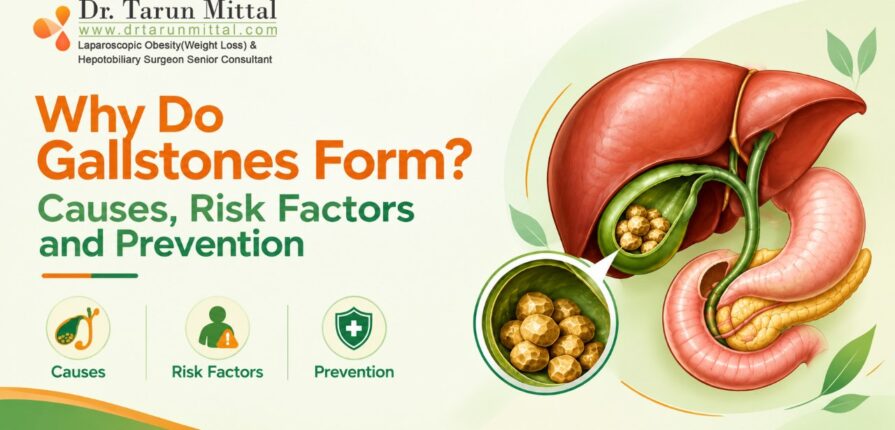
Why Do Gallstones Form? Causes, Risk Factors and Prevention
Gallstones are strange little things. They can sit quietly for years. No warning. No drama. Then one evening, often after a rich or fatty meal, a sharp pain suddenly grips the upper-right side of the abdomen and refuses to be ignored.
So, how does something resembling a tiny pebble end up inside the gallbladder in the first place?
According to Dr Tarun Mittal, understanding why gallstones form is useful because gallbladder trouble doesn’t always begin with obvious symptoms. The problem often develops gradually, long before that first painful episode sends someone searching for medical help.
First, What Exactly Are Gallstones?
The gallbladder is a small, pear-shaped organ tucked beneath the liver. Its main job is straightforward: store bile produced by the liver and release it when the body needs help digesting fats.
Bile contains cholesterol, bile salts, bilirubin and other substances. Usually, these remain properly balanced. Sometimes they don’t.
That’s when trouble starts.
If bile contains too much cholesterol or bilirubin, or the gallbladder doesn’t empty properly, tiny crystals may begin forming. Think of sugar settling at the bottom of an overly sweet cup of tea. Those crystals can gradually clump together and harden into gallstones.
Some remain almost grain-sized. Others grow considerably larger.
What Causes Gallstones to Form?
There isn’t one single culprit.
Excess cholesterol in bile is one common reason. If the liver releases more cholesterol than the bile can dissolve, that extra cholesterol can crystallise and eventually become a stone.
Then there’s bilirubin. Certain medical conditions can cause the body to produce unusually high amounts of it, increasing the likelihood of pigment gallstones.
And sometimes the gallbladder simply doesn’t empty completely or often enough. Bile sits there. It becomes concentrated. Stones get an opportunity to form.
Simple mechanism. Potentially painful consequences.
Who Is More Likely to Develop Gallstones?
Anyone can develop them, but certain factors tilt the odds.
Obesity is an important one. Rapid weight loss can also raise the risk — slightly ironic, perhaps, but losing a large amount of weight very quickly can alter cholesterol levels in bile and affect normal gallbladder emptying.
Risk may also increase with age, pregnancy, diabetes, a family history of gallstones and diets that are particularly high in fat or refined carbohydrates.
Women may develop gallstones more frequently because hormonal factors, including oestrogen, can influence cholesterol levels in bile.
Does having one risk factor guarantee gallstones?
Not a chance.
It simply means paying attention makes more sense.
Can Gallstones Be Prevented?
There’s no magic food that guarantees a gallstone-free life. Prevention is much less exciting than that.
Maintain a healthy weight. Lose excess weight gradually rather than through crash diets. Eat regular meals. Include fibre-rich foods such as vegetables, fruits and whole grains, while keeping excessive saturated and unhealthy fats under control.
Movement matters too. Regular physical activity supports weight management and overall metabolic health.
Small habits. Repeated consistently. That’s usually where prevention lives.
When Do Gallstones Need Treatment?
Here’s the catch: gallstones that cause no symptoms may not always require treatment. But recurring upper abdominal pain, nausea, vomiting, fever or complications such as gallbladder inflammation need medical evaluation.
When symptomatic gallstones repeatedly cause trouble, removing the gallbladder may be recommended rather than simply waiting for another attack.
Patients looking for the Best Gallbladder Removal Surgery in Delhi should focus on proper diagnosis, the surgeon’s experience, the suitability of minimally invasive techniques and a clear discussion of recovery expectations rather than treating surgery like a one-size-fits-all decision.
Dr Tarun Mittal specialises in laparoscopic and minimally invasive surgical care, including the management of gallbladder conditions.
Gallstones can be tiny.
Their consequences aren’t always.
Recognising the risk factors early — and knowing when persistent symptoms deserve medical attention — can make a very real difference.